






How Stainless Steel Defeats Corrosion: A Metallurgical Guide
- Views:0
- Author:
- Publish Time:2026-08-27
- Origin:
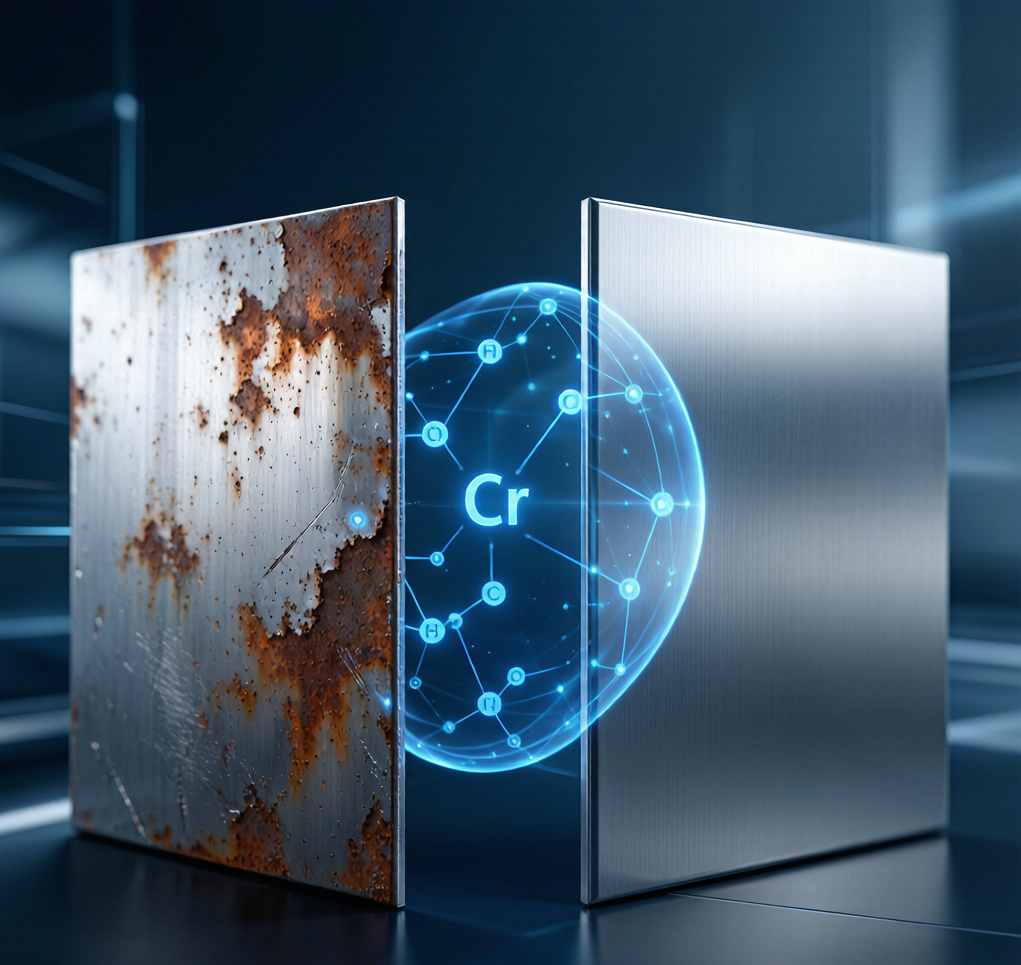
The outstanding longevity of stainless steel across industrial environments relies on precision metallurgy. Rather than depending on temporary surface coatings or paints, stainless steel derives its self-healing corrosion resistance from a microscopic, chromium-rich passive film that forms naturally when exposed to oxygen.
4 Key Metallurgical Factors Driving Corrosion Performance
Chromium & Self-Healing Oxide Formation: Containing a minimum of 10.5% chromium, stainless steel forms an invisible, inert chromium oxide ($\text{Cr}_2\text{O}_3$) passive layer that blocks moisture and corrosive agents. If scratched or damaged mechanically, this surface layer self-heals almost instantaneously in the presence of oxygen. For example, standard Grade 304 contains roughly 18% chromium, making it highly effective against general atmospheric rust in commercial architectural cladding and food-processing equipment.
Nickel & Austenitic Phase Stabilization: Adding 8% to 10% nickel to the alloy—as seen in classic 304 and 316 grades—stabilizes the face-centered cubic (austenitic) crystal structure. This microscopic phase improves mechanical ductility, impact toughness at sub-zero temperatures, and general resistance to acidic environments. In marine transport and coastal infrastructure, nickel content prevents stress corrosion cracking under continuous salt fog exposure.
Molybdenum & Nitrogen for Chloride Defense: In harsh environments containing aggressive chlorides (such as seawater or chemical processing media), standard oxide films can suffer localized breakdown. Incorporating 2% to 3% molybdenum alongside trace nitrogen drastically inhibits localized pitting and crevice corrosion, ensuring long-term structural integrity in pharmaceutical piping and marine hardware.
PREN Quantification & Material Selection: Engineers evaluate alloy corrosion performance using the Pitting Resistance Equivalence Number formula: $\text{PREN} = \%\text{Cr} + 3.3(\%\text{Mo}) + 16(\%\text{N})$. Standard Grade 304 achieves a PREN score of approximately 19, whereas Grade 316 (with added molybdenum) reaches a PREN of 23 to 25. In high-salinity seawater desalination plants, super duplex grades with PREN values exceeding 40 are routinely specified to eliminate pitting risks entirely.
Select the Right Corrosion-Resistant Alloy Today
Understanding the chemical interplay between chromium, nickel, and molybdenum ensures you select the precise stainless steel grade for your specific operational environment.
Contact our metallurgical engineering team today to request technical datasheets, chemical compatibility charts, and custom alloy quotes for your next project.


